Many people today wander through loneliness, confusion, and spiritual exhaustion. We have experienced devastation caused by natural calamities such as earthquakes. We also witness the unresolved impasse among Philippine senators, which contributes to political instability. People are directly affected by these realities, and yet the Responsorial Psalm 99 today reminds us that God’s kindness and faithfulness never fail for “We are his people, the sheep of his flock.”
We are now returning to Ordinary Time in the Church’s liturgical calendar. After the overflowing graces of the Easter Season and the great feasts that culminated in last Sunday’s Feast of Corpus Christi, we continue our journey with the God who nourishes us with His Body and Blood in the Eucharist. The Eucharist remains our daily sustenance, strengthening us to persevere on our pilgrimage toward our eternal destiny in union with Him.
Today, on the 11th Sunday in Ordinary Time, Year A, all the readings unfold God’s loving relationship with us, His holy people.
In the first reading from the Book of Exodus, we hear how God carried the people of Israel “on eagles’ wings.” The Israelites are reminded to keep His covenant so that they may become a holy nation. Having escaped slavery in Egypt, they were tired, uncertain, and still carrying the wounds of oppression. Yet God speaks tenderly through Moses: “I bore you up on eagle wings and brought you here to myself.” Before giving commandments, God first gives them a sense of belonging. He reminds them that they are His treasured possession, “a kingdom of priests, a holy nation.” God first tells them who they are.
In the second reading from the Letter of St. Paul to the Romans, we are reminded of humanity’s failure to obey the voice of the Lord. Yet, in His compassion, God manifests His love by sending His Son, who offers Himself for us as an ocean of mercy. We are invited to place our trust in the Lord’s overflowing mercy and saving love.
I invite you to focus on Matthew’s Gospel for a clearer understanding of the Church’s evangelizing mission and the work Christ calls each of us to undertake according to His will. As disciples, we are challenged to return conscientiously to the work of evangelization.
First, Jesus looks upon the crowds and is “moved with pity” because they are “like sheep without a shepherd.” Christ is deeply aware of human suffering. He sees our brokenness and afflictions. His heart is wounded by the struggles of humanity, yet He never ceases to lift us up with love and compassion.
Jesus is not only taking pity on the crowd before Him. His concern extends to the whole Church and indeed to the entire human family. This Gospel reveals the mission of Christ that began with the first disciples and continues through every generation, including our own.
Second, Jesus says, “The harvest is abundant but the laborers are few.” God never abandons the world, but too few are willing to follow Him and serve others with His compassion.
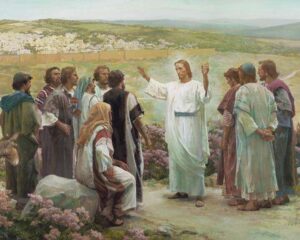
Jesus then calls the Twelve Apostles and sends them forth. These are ordinary people—fishermen, tax collectors, imperfect men with fears and weaknesses. Yet He entrusts them with an extraordinary mission: to heal, to proclaim hope, and to bring the Kingdom of God near. They are wounded healers. We, too, are called to continue their mission. Our Christian life is not merely about fulfilling the minimum obligation of attending Mass. It is about spreading God’s love and mercy in ordinary places and everyday situations—in hospitals, homes, workplaces, schools, and communities.
Third, Jesus gives His Apostles “authority over unclean spirits, to raise the dead, to drive them out and to cure every disease and every illness.”
Inspired by this gift of authority, we too are commissioned to work for the building up of God’s Kingdom.
From this Gospel, we learn an important characteristic of missionary discipleship: before we are sent, we are first invited by Jesus. The disciples do not set out on their own initiative. Their mission begins with Christ’s call.
Today, what does this missionary work entail for you and me? Certainly, the work we do is ultimately Christ’s work. We are His collaborators, eager to support and accompany people in their struggles, weaknesses, and helplessness.
The Church is calling us not only to get back to work but also to remember whose work it truly is and in whom we labor. It is Christ who lives in us (Galatians 2:20).
Am I willing to become a worker in God’s harvest? Sure, we can! Jesus says, “Without cost you have received, without cost you are to give.”
Let us continue pressing forward in sowing the good seed, trusting that the Lord of the harvest remains ever present and continues to guide His Church.
God bless you.
Fr. Arlon, OSA
El Dictado del Corazón: Onceavo Domingo del Tiempo Ordinario, Ciclo A
- Ex 19, 2-6a
- Sal 100 (99), 1-2, 3, 5
- Rom 5, 6-11
- Mt 9, 36–10, 8
En estos tiempos muchas personas vagan en medio de la soledad, la confusión y el agotamiento espiritual. Hemos experimentado la devastación causada por los terremotos, y los desacuerdos aún no resueltos entre los senadores filipinos, lo que contribuye a la inestabilidad política. Las personas se ven afectadas directamente por estas realidades y, sin embargo, el Salmo Responsorial 99 de hoy nos recuerda que la bondad y la fidelidad de Dios nunca fallan porque “Somos su pueblo, las ovejas de su rebaño”.
Ahora regresamos al Tiempo Ordinario en el calendario litúrgico de la Iglesia. Después de las abundantes gracias del Tiempo Pascual y de las grandes solemnidades que culminaron el domingo pasado con la Fiesta del Corpus Christi, continuamos nuestro camino con el Dios que nos alimenta con su Cuerpo y su Sangre en la Eucaristía. La Eucaristía sigue siendo nuestro sustento diario, fortaleciéndonos para perseverar en nuestra peregrinación hacia nuestro destino eterno en unión con Él.
Hoy, en el Onceavo Domingo del Tiempo Ordinario, Ciclo A, todas las lecturas nos revelan la relación amorosa de Dios con nosotros, su pueblo santo.
En la primera lectura, tomada del Libro del Éxodo, escuchamos cómo Dios llevó al pueblo de Israel “sobre alas de águila”. A los israelitas se les recuerda que deben guardar su alianza para convertirse en una nación santa. Después de haber escapado de la esclavitud en Egipto, estaban cansados, inseguros y todavía cargaban las heridas de la opresión. Sin embargo, Dios les habla con ternura por medio de Moisés: “Los traje sobre alas de águila y los conduje hasta mí”. Antes de darles mandamientos, Dios primero les da un sentido de pertenencia. Les recuerda que son su posesión más preciada, “un reino de sacerdotes y una nación santa”. Dios primero les dice quiénes son.
En la segunda lectura, tomada de la Carta de san Pablo a los Romanos, se nos recuerda el fracaso de la humanidad para obedecer la voz del Señor. Sin embargo, en su compasión, Dios manifiesta su amor enviando a su Hijo, quien se ofrece por nosotros como un océano de misericordia. Se nos invita a poner nuestra confianza en la misericordia desbordante y en el amor salvador del Señor.
Los invito a centrar su atención en el Evangelio según san Mateo para comprender con mayor claridad la misión evangelizadora de la Iglesia y la obra que Cristo llama a cada uno de nosotros a realizar conforme a su voluntad. Como discípulos, estamos llamados a retomar con responsabilidad y conciencia la tarea de la evangelización.
En primer lugar, Jesús mira a la multitud y se conmueve profundamente porque estaban “como ovejas sin pastor”. Cristo conoce profundamente el sufrimiento humano. Ve nuestras heridas y aflicciones. Su corazón se duele por las luchas de la humanidad, pero nunca deja de levantarnos con amor y compasión.
Jesús no siente compasión solamente por la multitud que tiene delante. Su preocupación se extiende a toda la Iglesia y, de hecho, a toda la familia humana. Este Evangelio revela la misión de Cristo, que comenzó con los primeros discípulos y continúa a través de cada generación, incluida la nuestra.
En segundo lugar, Jesús dice: “La cosecha es mucha y los trabajadores pocos”. Dios nunca abandona al mundo, pero son pocos los que están dispuestos a seguirlo y servir a los demás con su misma compasión.
Entonces Jesús llama a los Doce Apóstoles y los envía. Son personas comunes: pescadores, recaudadores de impuestos, hombres imperfectos con miedos y debilidades. Sin embargo, Él les confía una misión extraordinaria: sanar, anunciar la esperanza y acercar el Reino de Dios. Son sanadores heridos. Nosotros también estamos llamados a continuar su misión. Nuestra vida cristiana no consiste solamente en cumplir con la obligación mínima de asistir a la Misa. Se trata de difundir el amor y la misericordia de Dios en los lugares ordinarios y en las situaciones cotidianas: en los hospitales, los hogares, los lugares de trabajo, las escuelas y las comunidades.
En tercer lugar, Jesús concede a sus Apóstoles “autoridad sobre los espíritus impuros, para expulsarlos, para resucitar a los muertos y para curar toda enfermedad y dolencia”.
Inspirados por este don de autoridad, también nosotros somos enviados a trabajar por la construcción del Reino de Dios.
De este Evangelio aprendemos una característica importante del discipulado misionero: antes de ser enviados, primero somos llamados por Jesús. Los discípulos no parten por iniciativa propia. Su misión comienza con el llamado de Cristo.
Hoy, ¿qué implica este trabajo misionero para ti y para mí? Ciertamente, la obra que realizamos es, en última instancia, la obra de Cristo. Nosotros somos sus colaboradores, deseosos de apoyar y acompañar a las personas en sus luchas, debilidades e impotencia.
La Iglesia nos llama no solamente a volver al trabajo, sino también a recordar de quién es realmente esta obra y para quién trabajamos. Es Cristo quien vive en nosotros (Gálatas 2, 20).
¿Estoy dispuesto a convertirme en un trabajador de la cosecha de Dios? ¡Claro que sí! Jesús nos dice: “Gratis lo recibieron; denlo gratis”.
Sigamos adelante sembrando la buena semilla, confiando en que el Señor de la mies permanece siempre presente y continúa guiando a su Iglesia.
Que Dios los bendiga.
P. Arlon, OSA