Throughout this past week, I had the grace of journeying with the four Sisters of Our Lady of Sorrows during their canonical retreat. It was a profound privilege to accompany them and facilitate their spiritual retreat as they renewed their vocation and clarified the deepest motives of their religious consecration. Through our conferences, moments of silence, prayer, and spiritual direction, I witnessed how God’s grace gently enlightened their hearts with the light of Christ.
Their sincere openness to the Lord reminded me that every authentic renewal requires a process. Like every disciple, they are continually invited to deepen their intimacy with God so that their lives may bear more abundant fruit in mission. Their joyful receptivity, generous perseverance, and fidelity as religious sisters inspired me deeply. I am equally grateful to our Augustinian community for extending warm hospitality to them, making both their spiritual and physical journey a truly meaningful experience.
Today’s readings beautifully echo that experience. On this 13th Sunday in Ordinary Time, God invites us to reflect on the dictate of the heart. Every day our hearts make decisions. They determine whom we love, whom we trust, what we value most, and ultimately whom we follow. Jesus challenges us today to allow our hearts to be governed not by fear, comfort, or self-interest, but by God alone.
In the 1st reading from the Second Book of Kings, we meet the generous Shunammite woman. She welcomed the Prophet Elisha into her home, recognizing him as “a holy man of God.” Her hospitality was not motivated by the desire for recognition or reward. It flowed naturally from a heart filled with faith and generosity. She simply desired to serve.
God never allows genuine generosity to go unnoticed. Through the prophet Elisha, the childless couple received an unexpected blessing. Before leaving, Elisha promised her, “This time next year you will be holding a son in your arms.” Her hospitality became the doorway through which God’s miraculous blessing entered her life.
The 2nd reading taken from the Letter of St. Paul to the Romans, reminds us that through Baptism we have died to our old self—the self enslaved by sin, selfishness, pride, and worldly attachments. United with Christ in His death and Resurrection, we have become a new creation. Our lives are no longer centered on ourselves but on Christ, who emptied Himself completely out of love for humanity.
To be baptized, therefore, is not simply to belong to the Church. It is to allow Christ to reshape our hearts so that we may live entirely for God.
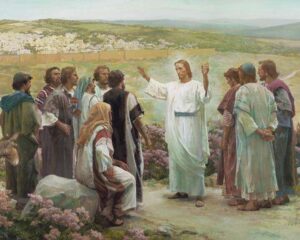
The gospel from St. Matthew presents one of the most demanding teachings of Jesus. At first glance, His words may seem severe, but they reveal the true cost and incomparable beauty of discipleship.
First, Jesus declares:”Whoever loves father or mother more than me is not worthy of me.” These words do not diminish the importance of family. Rather, Jesus reminds us that our first and absolute allegiance belongs to God. Only when Christ occupies the first place in our hearts can we truly love our families with greater freedom, purity, and selflessness.
When God becomes our highest priority, every other relationship finds its proper place. Our homes become places of forgiveness rather than resentment, of service rather than selfishness, and of joy rather than division.
For the early Christians, this teaching was painfully real. Many suffered rejection from their own families because of their faith in Christ. Every day they faced the difficult choice between preserving family approval and remaining faithful to the Gospel.
That same struggle continues today, although in different forms. Choosing honesty over corruption, truth over convenience, forgiveness over revenge, or fidelity over compromise often comes at a personal cost. Yet Jesus assures us that no sacrifice made for Him is ever in vain.
Learning to surrender ourselves to Christ is a lifelong journey. It requires daily conversion, perseverance, and trust. Thankfully, we never walk alone. The Holy Spirit continually strengthens us, guiding us whenever our hearts grow weary.
Second, Jesus says, “Whoever does not take up his cross and follow me is not worthy of me.”
Discipleship without the Cross does not exist.
To follow Christ means embracing sacrifice, accepting suffering with faith, and living generously for others. The Cross is not merely a burden to endure; it is the path that leads to resurrection. Every act of forgiveness, every hidden sacrifice, every patient endurance of trials, and every generous service offered out of love becomes participation in Christ’s own saving work.
We often seek comfort and security. Yet if our Christian life never challenges us, never stretches our generosity, never calls us beyond ourselves, then perhaps we have settled for comfort instead of discipleship.
Jesus never promised an easy life. He promised His presence. And His presence gives meaning even to our crosses.
Third, Jesus says, “Whoever welcomes you welcomes me, and whoever welcomes me welcomes the One who sent me.” These words reveal a profound theological truth. Every person who stands before us carries the image of God. To welcome another is to welcome Christ Himself; and to welcome Christ is to welcome the Father who sent Him.
Hospitality, therefore, is far more than good manners. It becomes a sacred encounter with God. This gospel passage reminds us that even something as simple as offering a cup of cold water to one of Christ’s little ones will never be forgotten by God. No act of kindness is ever too small when it is inspired by love.
In a world increasingly marked by indifference, suspicion, and division, Christians are called to become living signs of God’s welcoming love. Our homes, our communities, and our parishes should always reflect the compassionate heart of Christ.
As we celebrate this Eucharist, our prayers naturally extend beyond ourselves. We remember our brothers and sisters affected by the recent shooting incident in Tacloban, as well as those suffering from earthquakes in Venezuela, Japan, the Philippines, and California. May the Lord grant eternal rest to those who have died, healing to the injured, comfort to grieving families, and strength to all those assisting in rescue and recovery efforts.
My dear brothers and sisters, today’s Gospel ultimately asks only one question: Who truly governs our hearts?
If our hearts are ruled by Christ, we will choose Him above every earthly attachment. We will embrace the Cross with hope. We will welcome others with generous love. We will become faithful missionary disciples whose lives reveal the presence of Jesus to the world.
May we never lose sight of Christ by allowing self-interest, comfort, or worldly ambitions to take His place. Instead, may we imitate His welcoming heart, His self-emptying love, and His unwavering fidelity to the Father.
May Mary, whose heart was perfectly united with the Heart of her Son, teach us to live according to the dictate of God’s love each day.
God bless you.
Fr. Arlon, OSA