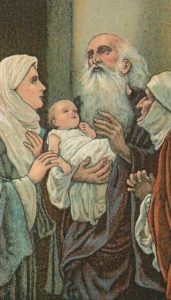
Today we celebrate the Feast of the Presentation of the Lord and the World Day for Consecrated Life. This World Day for consecrated life is closely tied to the presentation of the Lord in the temple. It is Mary and Joseph offering the Infant Jesus to fulfill what the law has required of the Holy Family. Being faithful Jews, they have fulfilled completely their religious tradition. In the same manner, by professing our religious vows, we are presented to the Almighty God for complete commitment and consecration through our evangelical vows of poverty, chastity and obedience. Let us offer prayers for those men and women who offered their lives to Christ. I am one of those men who offered my life to the consecrated life by being a religious priest.
Forty days after Christmas Day, the feast of the Presentation of the Lord has been observed annually. Mary and Joseph took the Infant Jesus for his first visit to the temple in Jerusalem. We recall that this observance connects to the fulfillment and obedience to the Law and the guidance to accept Jesus, who is the new temple of God leading everyone to the promise of salvation. We are all drawn to the words of the Prophet Simeon prophesying that the child will become “a light for the revelation of the Gentiles.”
This feast has also been known as Candlemas because of the tradition of blessing and distributing candles to remind us that Jesus is the Light and the revelation of His coming in the place in which the law of sacrifice and love come to fulfillment.
The gospel today from the evangelist St. Luke narrates to us about the Holy family going to the temple in Jerusalem to worship God and to offer a “ransom” or sacrifice for their son, Jesus, as their firstborn child. We are invited to allow the Holy Spirit to enlighten us to understand further this particular episode in the life of Jesus.
First, how do we comprehend the so called “ransom offering” for their son? Jesus is the Son of God, so why do Mary and Joseph offer a ransom? The answer can be found in the understanding of the Old Testament record in the Book of Exodus 13:14-15, “And when your son asks you later on, ‘What does this mean?’ you will tell him, ‘With a strong hand the Lord brought us out of Egypt, out of a house of slavery. When Pharaoh stubbornly refused to let us go, the Lord killed every firstborn in the land of Egypt, the firstborn of human being and beast alike. That is why I sacrifice to the Lord every male that opens the womb and why I ransom every firstborn of my sons’.” (13:14-15) These two verses present to us the origin of offering a ransom to remind them of God’s love and salvation for all. Mary and Joseph’s offering corresponds to their status being part of the “Anawim” of God, poor people and yet totally dependent on God, and so according to the law, they could offer a pair of turtledoves to ransom their firstborn. This kind of animal sacrifice served as a reminder of what God has done for His people under the difficult experience from the Egyptian cruelty, and God protects and saves them all those years.
Second, this event is not only presenting Jesus with their offering of sacrifice, but after, received the revelation of Jesus’ divine origin. It was for Mary and Joseph, the presentation of Jesus connects with the continuous action of God’s salvific intentionality, a divine plan of salvation which began in Egypt.
Third, two elderly people are mentioned in this gospel, Prophet Simeon and Prophetess Anna, both ministering at the temple and patiently waiting for the promised messiah before their holy death. They find joy in their watchfulness, as they “worshiped night and day with fasting and prayer.” Simeon was touched by the Holy Spirit, and he explicitly identified Jesus as the Christ, the Anointed One, through whom God would bring definitive and lasting salvation to His people, while Prophetess Anna offered continued prayers of thanksgiving to God.
Like Simeon and Anna, let us continuously bring to our attention the very presence of God in our daily adoration, prayers and meditations. In our ordinary and everyday life, we must listen to the promptings of the Holy Spirit with graceful expectation to make us closer to Jesus Christ, our Savior. We can share Jesus to others just like sharing the light to another candle but not losing and extinguishing our candle’s light. Such is the power of Christ’s presence to others.
May the Blessed Virgin Mary and St. Joseph share with us the blessing and grace to recognize the wisdom and the saving action of the Almighty God in which salvation indeed manifests through our active cooperation in the mysterious workings of the Holy Spirit. God is still continuously working in the world through our humility and kindness. Let us live in freedom, obedience and gratefulness.
God bless you.
Fr. Arlon, osa
——————
El Dictado del Corazón: La Presentación del Señor, Año C
- Malaquías 3:1-4
- Salmos 24:7-10
- Hebreos 2:14-18
- Lucas 2:22-40
Hoy celebramos la Fiesta de la Presentación del Señor y el Día Mundial de la Vida Consagrada. Este Día Mundial de la Vida Consagrada está estrechamente relacionada con la presentación del Señor en el templo. Es María y José ofreciendo al Niño Jesús para cumplir con lo que la ley requería para la Santa Familia. Siendo judíos fieles, han cumplido completamente con su tradición religiosa. De igual manera, profesando nuestros votos religiosos, nos presentamos ante el Dios Todopoderoso para un compromiso y consagración completos a través de nuestros votos evangélicos de pobreza, castidad y obediencia. Oremos por aquellos hombres y mujeres que ofrecieron sus vidas a Cristo. Yo soy uno de esos hombres que ofreció su vida a la vida consagrada, siendo sacerdote religioso.
Cuarenta días después del Día de Navidad, se ha observado anualmente la fiesta de la Presentación del Señor, cuando María y José llevan al Niño Jesús a su primera visita al templo de Jerusalén. Recordamos que esta observancia está vinculada al cumplimiento y la obediencia a la Ley, así como a la aceptación de Jesús, quien es el nuevo templo de Dios, guiando a todos hacia la promesa de la salvación. Todos nos sentimos atraídos por las palabras del Profeta Simeón, quien profetiza que el niño será “luz para revelación de los gentiles.”
Esta fiesta también se conoce como la Fiesta de la Candelaria debido a la tradición de bendecir y distribuir velas, para recordarnos que Jesús es la Luz, la revelación de Su venida en el lugar donde la ley del sacrificio y el amor se cumplen.
El evangelio de hoy, según el evangelista San Lucas, nos narra sobre la Santa Familia y su visita al templo de Jerusalén para adorar a Dios y ofrecer un “rescate” o sacrificio por su hijo, Jesús, como su primogénito. Se nos invita a permitir que el Espíritu Santo nos ilumine para entender más profundamente este episodio particular en la vida de Jesús.
En primer lugar, ¿cómo comprendemos lo que se llama la “ofrenda de rescate” por su hijo? Jesús es el Hijo de Dios, ¿por qué María y José ofrecen un rescate? La respuesta se encuentra en la comprensión del registro del Antiguo Testamento en el Libro del Éxodo 13:14-15: “Y cuando tu hijo te pregunte más tarde, ‘¿Qué significa esto?’, le dirás: ‘Con mano fuerte el Señor nos sacó de Egipto, de la casa de la esclavitud. Cuando el faraón se negó obstinadamente a dejarnos ir, el Señor mató a todo primogénito en la tierra de Egipto, tanto de seres humanos como de animales. Por eso yo sacrifico al Señor todo varón que abre el vientre, y por eso redimo a todo primogénito de mis hijos’” (13:14-15). Estos dos versículos nos presentan el origen de la ofrenda de un rescate, recordando el amor y la salvación de Dios para todos. La ofrenda de María y José corresponde a su condición de ser parte de los “Anawim” de Dios, gente pobre y, sin embargo, completamente dependiente de Dios. Por lo tanto, de acuerdo con la ley, podían ofrecer un par de tórtolas para redimir a su primogénito. Este tipo de sacrificio animal servía para recordar lo que Dios había hecho por Su pueblo, durante la difícil experiencia de la crueldad en Egipto, y cómo Dios los protegió y los salvó durante todos esos años.
En segundo lugar, este evento no solo presenta a Jesús con su ofrenda de sacrificio, sino que después de recibir la revelación del origen divino de Jesús. Para María y José, la presentación de Jesús está conectada con la continua acción de la intención salvífica de Dios, un plan divino de salvación que comenzó en Egipto.
En tercer lugar, hay dos personas mayores mencionadas en este evangelio, el Profeta Simeón y la Profetisa Ana. Ambos ministrando en el templo, esperando pacientemente al Mesías prometido antes de su santa muerte. Encuentran alegría en su vigilancia, ya que “adoraban noche y día con ayunos y oraciones.” Simeón fue tocado por el Espíritu Santo, y explícitamente identificó a Jesús como el Cristo, el Ungido, a través del cual Dios traería una salvación definitiva y perdurable a Su pueblo. Mientras tanto, la Profetisa Ana ofrecía oraciones continuas de acción de gracias a Dios.
Al igual que Simeón y Ana, permitámonos traer continuamente a nuestra atención la presencia misma de Dios en nuestra adoración diaria, oraciones y meditaciones. En nuestra vida ordinaria y diaria, debemos escuchar las inspiraciones del Espíritu Santo con una esperanzada expectativa para acercarnos más a Jesucristo, nuestro Salvador. Podemos compartir a Jesús con los demás, de la misma manera que compartimos la luz de una vela a otra, pero sin perder ni extinguir la luz de nuestra propia vela. Tal es el poder de la presencia de Cristo para los demás.
Que la Santísima Virgen María y San José nos compartan la bendición y la gracia de reconocer la sabiduría y la acción salvadora del Dios Todopoderoso, en la cual la salvación se manifiesta verdaderamente a través de nuestra cooperación activa en los misteriosos trabajos del Espíritu Santo. Dios sigue trabajando continuamente en el mundo a través de nuestra humildad y bondad. Vivamos en libertad, obediencia y gratitud.
Que Dios los bendiga.
P. Arlon, osa