I recently had an enriching retreat with my Augustinian brothers of the Province of Santo Niño de Cebu. It had been a long time since I last joined the Augustinian Friars’ retreat—our annual moment of spiritual renewal and ongoing formation.
This year’s retreat master came from The Augustinians of the Assumption, a congregation that also embraces the Rule and teachings of St. Augustine. Fr. Bernard Holzer, AA, guided us through five themes that illuminate our calling to be “Pilgrims and Witnesses of Hope with St. Augustine.” These themes—Interiority, Community Life, the Common Good, Love for the Church, and Mission as the Passing of the Torch, renewed our enthusiasm to live as consecrated men inspired by our Holy Father Augustine. Our retreat concluded with the celebration of the Presentation of Mary, reminding us that we too are called to rededicate and renew our consecration to God.
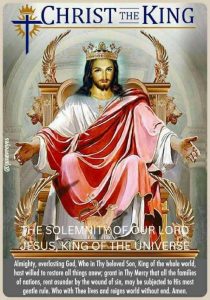
Today, as we celebrate the final Sunday of the liturgical year—Year C—on the Solemnity of Christ the King, we see how the entire liturgical cycle leads us toward this ultimate truth: Jesus is our King.
In the first reading, from the Second Book of Samuel, we hear of the anointing of David as king, though the people did not immediately acknowledge his kingship. This echoes the experience of Jesus, the true King, who also went unrecognized by many.
The second reading, from St. Paul’s Letter to the Colossians, is a hymn proclaiming Jesus as the firstborn of all creation and the head of all things. Everything belongs to Him, yet He chooses to care for us as a shepherd cares for his flock.
The Gospel today brings us to Calvary. Even as soldiers mocked Him, the inscription above the cross still proclaimed Him “King of the Jews.” Here, the mystery of our faith shines through: on the cross, the glory of Christ’s kingship is revealed—not in power or splendor, but in humility and sacrificial love.
First, the rulers sneer at Jesus: “He saved others; let him save himself if he is the chosen one.” The soldiers, who clearly did not believe, also mock Him. Yet faith allows us to see what they could not: that the crucified Jesus is truly King and Savior. Throughout the Gospels, we encounter many such divine surprises—where the poor become rich, sinners find salvation, and the kingdom of God appears in hidden, unexpected ways.
Second, the inscription “This is the King of the Jews,” meant as ridicule, becomes a profound declaration of truth. While leaders jeer, the repentant thief recognizes Jesus as Messiah and King—and receives the promise of salvation.
Third, Jesus’ sovereignty is not about political authority, wealth, or domination. It is about love, mercy, and peace. When Jesus tells the repentant thief, “Amen, I say to you, today you will be with me in Paradise,” He reveals what God’s kingship truly means: self-giving love for the sake of all humanity. Jesus unites His people not only through His leadership but through His very person. His kingdom is built not on might, but on compassion and sacrifice.
Today’s Gospel invites each of us to make our own judgment: with the eyes of faith, can we recognize the crucified Jesus as our King?
As modern disciples, we often struggle to acknowledge Christ as King in our daily lives. Yet He continues to call us to kindness, service, forgiveness, and humble love. His greatest victory was won on the cross, where He absorbed evil and responded with mercy. And we, His followers, are called to take part in this mission—His “army,” not of force, but of love.
This feast also fills us with hope. Christ’s kingdom is not broken, divided, or temporary. It is eternal, united, and filled with peace. When we live in His love, we already begin to share in the joy of His kingdom—here and now, and in the life to come.
God bless you,
Fr. Arlon, OSA
El Dictado del Corazón
La Solemnidad de Cristo Rey, Año C
- 2 Samuel 5, 1–3
- Salmo 122, 1–2. 3–4. 4–5
- Colosenses 1, 12–20
- Lucas 23, 35–43
Hace poco tuve un retiro muy enriquecedor con mis hermanos agustinos de la Provincia del Santo Niño de Cebú. Hacía mucho tiempo que no participaba en el retiro de los frailes agustinos, nuestro momento anual de renovación espiritual y formación permanente.
El predicador de este año vino de los Agustinos de la Asunción, una congregación que también abraza la Regla y las enseñanzas de San Agustín. El P. Bernard Holzer, AA, nos guió a través de cinco temas que iluminan nuestra vocación a ser “Peregrinos y Testigos de la Esperanza con San Agustín.” Estos temas, la Interioridad, la Vida Comunitaria, el Bien Común, el Amor por la Iglesia y la Misión como el Paso de la Antorcha, renovaron nuestro entusiasmo por vivir como consagrados inspirados por nuestro Santo Padre Agustín. Nuestro retiro concluyó con la celebración de la Presentación de María, recordándonos que también nosotros somos llamados a rededicar y renovar nuestra consagración a Dios.
Hoy, al celebrar el último domingo del año litúrgico Año C en la Solemnidad de Cristo Rey, vemos cómo todo el ciclo litúrgico nos conduce a esta verdad definitiva: Jesús es nuestro Rey.
En la primera lectura, del Segundo Libro de Samuel, escuchamos la unción de David como rey, aunque el pueblo no reconoció inmediatamente su reinado. Esto refleja la experiencia de Jesús, el verdadero Rey, que también fue ignorado por muchos.
La segunda lectura, de la Carta de San Pablo a los Colosenses, es un himno que proclama a Jesús como el primogénito de toda la creación y la cabeza de todas las cosas. Todo le pertenece, y aun así Él elige cuidarnos como un pastor cuida a su rebaño.
El Evangelio de hoy nos lleva al Calvario. Aunque los soldados lo burlaban, la inscripción sobre la cruz proclamaba: “Éste es el Rey de los Judíos.” Aquí brilla el misterio de nuestra fe: en la cruz, la gloria del reinado de Cristo se revela no en poder o esplendor, sino en humildad y amor sacrificado.
Primero, los jefes del pueblo se burlan de Jesús: “A otros salvó; que se salve a sí mismo si es el elegido de Dios.” Los soldados, que claramente no creían, también se mofan de Él. Pero la fe nos permite ver lo que ellos no pudieron: que Jesús crucificado es verdaderamente Rey y Salvador. A lo largo de los Evangelios encontramos muchas de estas sorpresas divinas, donde los pobres se vuelven ricos, los pecadores encuentran salvación, y el Reino de Dios aparece de maneras ocultas e inesperadas.
Segundo, la inscripción “Éste es el Rey de los Judíos,” pensada como burla, se convierte en una profunda declaración de verdad. Mientras los líderes se mofan, el ladrón arrepentido reconoce a Jesús como Mesías y Rey, y recibe la promesa de la salvación.
Tercero, la soberanía de Jesús no se trata de autoridad política, riqueza o dominio. Se trata de amor, misericordia y paz. Cuando Jesús le dice al ladrón arrepentido: “Yo te aseguro: hoy estarás conmigo en el Paraíso,” revela lo que verdaderamente significa el reinado de Dios: un amor que se entrega por toda la humanidad. Jesús une a su pueblo no sólo a través de su liderazgo, sino por medio de su propia persona. Su Reino se edifica no con fuerza, sino con compasión y sacrificio.
El Evangelio de hoy nos invita a cada uno de nosotros a hacer nuestro propio discernimiento: con los ojos de la fe, ¿podemos reconocer al Jesús crucificado como nuestro Rey?
Como discípulos modernos, a menudo nos cuesta reconocer a Cristo como Rey en nuestra vida diaria. Sin embargo, Él continúa llamándonos a la bondad, al servicio, al perdón y al amor humilde. Su mayor victoria se logró en la cruz, donde absorbió el mal y respondió con misericordia. Y nosotros, sus seguidores, somos llamados a participar en esta misión, su “ejército,” no de fuerza, sino de amor.
Esta fiesta también nos llena de esperanza. El Reino de Cristo no está roto, dividido, ni es temporal. Es eterno, unido y lleno de paz. Cuando vivimos en su amor, ya comenzamos a participar de la alegría de su Reino, aquí y ahora, y en la vida eterna.
Dios les bendiga,
P. Arlon, OSA