We enter the first day of the month of March with the 2nd Sunday of Lent, Year A, in the Church’s liturgical calendar.
Our journey through Lent strengthens us in our quest for perseverance and the willingness to triumph over temptation and mediocrity. It opens our often fixed minds to the power of a merciful God.
Today’s readings focus on God’s promise of salvation and, by His grace, strengthen our faith—a faith that calls us to action.
In the first reading from the Book of Genesis, we hear about God’s promise of abundant blessings to Abram. It describes the transformation of a pagan patriarch into a believer in the one true God. His name was changed from Abram to Abraham, signifying his growth from the father of a small family to the father of a great nation. This great transformation began through God’s mercy and depended on Abram’s trust in Him. All Abram had to do was obey the Lord’s command and he did so.
In the second reading, from the First Letter of St. Paul to Timothy, Paul reminds us that God makes His grace available to those who fully trust Him, enabling them to grow in holiness. God “called us to a holy life.” Paul humbly insists that holiness is not something we can achieve on our own; it is the work of God within a community. It is God’s design for all humanity through Jesus Christ.
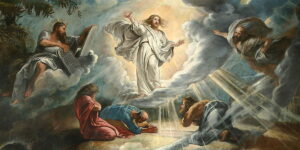
In the Gospel according to St. Matthew, we hear of one of the most important events in the life of Jesus: the Transfiguration. This event is also reported in the three Synoptic Gospels: Mark, Luke, and Matthew. To understand Matthew’s account of the Transfiguration, we must remember its context. Matthew places this story just after Jesus asks His disciples, “Who do you say that I am?” When Peter declares that Jesus is the Messiah, Jesus orders him to keep silent.
The word “Transfiguration” is not commonly used in everyday speech. If someone goes to the barber or salon for a makeover, we would not usually say, “You look transfigured today.” The word is reserved for something extraordinary. In Scripture, it is used to describe the striking change in Jesus’ appearance, revealing a glimpse of the glory of His Resurrection in the presence of John, Peter, and James—the inner circle of His apostles.
The lesson we draw from this Gospel passage leads us to a profound theological understanding.
First, a voice affirms that Jesus is God’s Son, echoing the voice heard at His baptism. On the mountain, Jesus reveals His identity once again when a bright cloud overshadows them and a heavenly voice, God the Father, declares, “This is my beloved Son, in whom I am well pleased; listen to him.” The Transfiguration is indeed a revelation of who Jesus truly is—a narrative we call a “Christophany.” It gives us a glimpse of the heavenly glory awaiting all who do God’s will by placing their trust and faith in Him.
Second, Moses and Elijah appear with Jesus on the mountain. How do we understand this? Their presence shows that this event is deeply connected to God’s relationship with the people of Israel. Moses and Elijah represent the Law and the Prophets, respectively. In the revelation and presence of the Beloved Son, Jesus completes and fulfills God’s Word.
Although the apostles wish to preserve the vision, Jesus commands them not to tell anyone about their experience. This reminds them not to proclaim Him as the Messiah prematurely, before the proper time.
St. Augustine, in one of his sermons, affirms that “after the Resurrection, neither Moses nor Elijah is seen. Only Jesus remains, for the Law and the Prophets have borne witness to Christ, who was destined to suffer, to rise again from the dead on the third day, and to enter into His glory.”
Third, the Transfiguration occurs in the presence of only three of Jesus’ disciples: Peter, James, and John. In Matthew’s Gospel, these disciples are among the first whom Jesus calls. They witness the Transfiguration so that they may be strengthened in times of trial.
When the evil one entices us to disobey God’s will and to serve ourselves as gods—turning our backs on Him and rejecting His love, grace, and salvation—we may easily yield to his lies and deception.
The story of Jesus’ Transfiguration reminds both the Apostles and us that our experience of the Eucharist is also transformative. The bread and wine become the Body and Blood of Christ. Likewise, each Mass should be a source of strength, leading to our own spiritual transformation.
We must renew and transform our lives during Lent so that we may radiate the glory and grace of the transfigured Lord.
The message of this gospel is clear: Jesus reveals His divine glory to His chosen disciples so that they may abandon worldly ambitions for power and prestige.
Lenten transformation is expected of us when we recognize the loving, providing, and disciplining hand of God behind our hardships, pain, and suffering. We are called to grow in holiness by cooperating with God’s grace, which encourages us each day.
Each Sacrament we receive transforms us. In particular, through the Sacrament of Reconciliation, God restores the sinner to the path of holiness—the original design He intended for each of us, so that we may be transformed and, in turn, help transform the world and society.
God bless you.
Fr. Arlon, OSA